Since the financial crisis and
the collapse of the financial system authorities see stress testing from vital
importance for financial institutions to shore up confidence in the financial
system. Stress testing is an analysis conducted under unfavorable economic
scenarios which is designed to determine whether a bank has enough capital to
withstand the impact of adverse developments by examination of their balance
sheets. Banks have to understand how robust their positions are to alternatives
of macro events and other stresses, no matter how implausible they seem. Their
existing risk structures and processes failed to account for the enormous
liquidity crunch following the collapse of Lehman Brothers. Stress testing is
pointed out as a very important tool to examine the structural challenges banks
are facing today and to understand their risk exposures (market risk, credit
risk, liquidity risk).
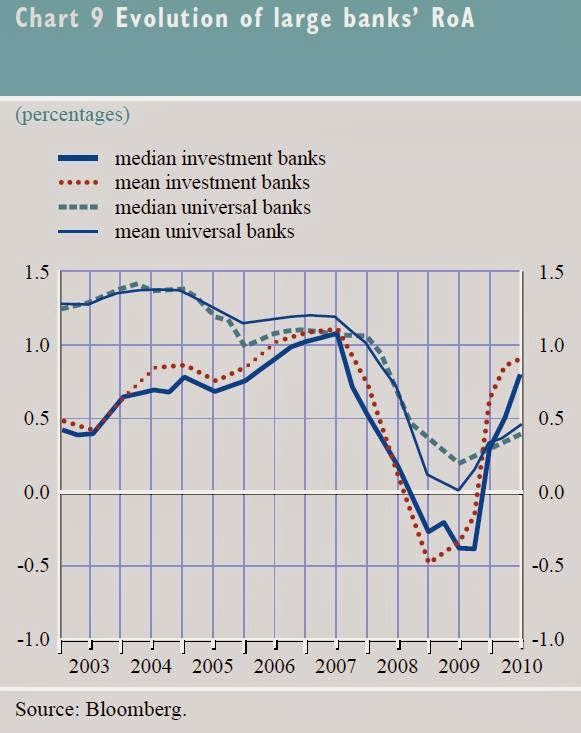
The financial crisis has highlighted the problems of over-reliance on quantitative models. The traditional performance measures (RoE and RoA) needs to be combined with more forward-looking risk tools and techniques. The European authorities, the EBA (European Banking Authority), ECB (European Central Bank) and European Systemic Risk Boards (ESRB) are strengthening bank stress testing procedures and their application. The exercises are used to evaluate bank’s plans to comply with the evolving capitalization requirements under EU’s latest Capital Requirement Directive CRD IV which is the implementation of the global agreed Basel III accords on banking capital and liquidity (8% core Tier 1 capital).
Incorporating banks’ reaction to shocks is a critical input into the design of informative stress tests, especially over long time horizons. This requires modeling solvency and liquidity shocks in a coherent manner because first, when banks react to financial stress, the source of the shock (solvency or liquidity) is not always clear and the measures that banks take in reaction to these shocks have both capital and liquidity aspects that are not easy to disentangle. It is clear that the stress tests scenarios need to encompass a much longer time horizon; incorporate structural shifts (e.g., ongoing deleveraging and changes of bank funding profiles) affecting the balance sheet and income; and emphasize more other metrics, such as profitability, and changes in RWA. Scenarios such as a benchmark scenario, a recession scenario or the impact of a sovereign debt shock to a recession are implemented during stress testing.
Are stress test possible to boost investors’ confidence? Can the added RQR safety measure save the euro zone and its financial institutions? The European Central bank is expected to release the results of its latest bank stress test in November, which involves reviewing the quality of bank assets and requiring those that fail to recapitalize. Not only conducting an in-depth asset quality review (AQR) but also a recapitalization quality review (RQR) will be necessary to supervise the euro zone’s largest banks. The AQR only reveals limited capital shortfalls, representing a fraction of the sector’s annual profits. An expanded RQR would address wider structural risks inherent in recapitalizing banks. It helps to highlight those banks where conventional recapitalization is impossible, and allow investors and national regulators to prepare for a potential bail-in.
In the stress test, any capital shortfall arising from either the baseline or the adverse scenario relative to agreed benchmarks will require a strengthening of capital buffers and/or other supervisory interventions, as will losses ascertained in the AQR. As the stress test results for the banks that are subject to the comprehensive assessment will incorporate capital requirements that may result from the AQR, the end result will be more demanding than in previous exercises conducted by the European authorities in 2011.

With respect to the selection of portfolios – AQR phase 1 – data for all 128 banks across the EU were submitted to the ECB on schedule in late December, followed by a data quality review undertaken in close cooperation with the NCAs. The collection of data focused on identifying the most risky portfolios for inclusion in the AQR and subject to the minimum criteria that selected portfolios must account for at least 50% of a bank’s risk-weighted assets in each country. Intensive work is currently under way to select, bank-by-bank, the portfolios to be reviewed. For banks operating in multiple countries, only the parent bank will be scrutinized. That process will end in mid-February.
We have seen that these tests are based on scenarios in which banks in each country fail or pass. Are these scenarios and the required Core Tier 1 Capital ratio of 8% right? Can stress testing conducted by the European authorities cover up the whole weakness in the European Banking system? Is there enough following up, coordination and transparency? Are the results coming from accurate data? Liquidity risk was a kind of sleeping risk we didn’t took into account in the past. Are there other risks that needs to be measured? The U.K.’s Prudential Regulatory Authority has said it is likely that it will also test banks on completely other test metrics such as the leverage ratios as a measure of capital adequacy because banks are using the benchmark risk-adjusted metrics to overstate their financial strength.
The financial crisis has highlighted the problems of over-reliance on quantitative models. The traditional performance measures (RoE and RoA) needs to be combined with more forward-looking risk tools and techniques. The European authorities, the EBA (European Banking Authority), ECB (European Central Bank) and European Systemic Risk Boards (ESRB) are strengthening bank stress testing procedures and their application. The exercises are used to evaluate bank’s plans to comply with the evolving capitalization requirements under EU’s latest Capital Requirement Directive CRD IV which is the implementation of the global agreed Basel III accords on banking capital and liquidity (8% core Tier 1 capital).
Incorporating banks’ reaction to shocks is a critical input into the design of informative stress tests, especially over long time horizons. This requires modeling solvency and liquidity shocks in a coherent manner because first, when banks react to financial stress, the source of the shock (solvency or liquidity) is not always clear and the measures that banks take in reaction to these shocks have both capital and liquidity aspects that are not easy to disentangle. It is clear that the stress tests scenarios need to encompass a much longer time horizon; incorporate structural shifts (e.g., ongoing deleveraging and changes of bank funding profiles) affecting the balance sheet and income; and emphasize more other metrics, such as profitability, and changes in RWA. Scenarios such as a benchmark scenario, a recession scenario or the impact of a sovereign debt shock to a recession are implemented during stress testing.
Are stress test possible to boost investors’ confidence? Can the added RQR safety measure save the euro zone and its financial institutions? The European Central bank is expected to release the results of its latest bank stress test in November, which involves reviewing the quality of bank assets and requiring those that fail to recapitalize. Not only conducting an in-depth asset quality review (AQR) but also a recapitalization quality review (RQR) will be necessary to supervise the euro zone’s largest banks. The AQR only reveals limited capital shortfalls, representing a fraction of the sector’s annual profits. An expanded RQR would address wider structural risks inherent in recapitalizing banks. It helps to highlight those banks where conventional recapitalization is impossible, and allow investors and national regulators to prepare for a potential bail-in.
In the stress test, any capital shortfall arising from either the baseline or the adverse scenario relative to agreed benchmarks will require a strengthening of capital buffers and/or other supervisory interventions, as will losses ascertained in the AQR. As the stress test results for the banks that are subject to the comprehensive assessment will incorporate capital requirements that may result from the AQR, the end result will be more demanding than in previous exercises conducted by the European authorities in 2011.
With respect to the selection of portfolios – AQR phase 1 – data for all 128 banks across the EU were submitted to the ECB on schedule in late December, followed by a data quality review undertaken in close cooperation with the NCAs. The collection of data focused on identifying the most risky portfolios for inclusion in the AQR and subject to the minimum criteria that selected portfolios must account for at least 50% of a bank’s risk-weighted assets in each country. Intensive work is currently under way to select, bank-by-bank, the portfolios to be reviewed. For banks operating in multiple countries, only the parent bank will be scrutinized. That process will end in mid-February.
We have seen that these tests are based on scenarios in which banks in each country fail or pass. Are these scenarios and the required Core Tier 1 Capital ratio of 8% right? Can stress testing conducted by the European authorities cover up the whole weakness in the European Banking system? Is there enough following up, coordination and transparency? Are the results coming from accurate data? Liquidity risk was a kind of sleeping risk we didn’t took into account in the past. Are there other risks that needs to be measured? The U.K.’s Prudential Regulatory Authority has said it is likely that it will also test banks on completely other test metrics such as the leverage ratios as a measure of capital adequacy because banks are using the benchmark risk-adjusted metrics to overstate their financial strength.